

Chapter 4: Who guards the guardians? The conflicting interests of investment arbitrators
When I wake up at night and think about arbitration, it never ceases to amaze me that sovereign states have agreed to investment arbitration at all [...] Three private individuals are entrusted with the power to review, without any restriction or appeal procedure, all actions of the government, all decisions of the courts, and all laws and regulations emanating from parliament.
Juan Fernández-Armesto, arbitrator from Spain1
Investment arbitrators are hidden from public view, barely mentioned in international media. This is perhaps not surprising, given that most people’s eyes glaze over at the mere mention of the words. Yet this small group of elite lawyers have been granted unprecedented power to judge cases that affect millions of people.
When companies sue governments in international arbitration tribunals, investment arbitrators have the power to divert taxpayers’ money to corporations. They can decide to penalise governments for ensuring people’s human rights to health, access to water or electricity as well as the right to a healthy environment. This field of law is certainly not short of technocratic detail and obtuse legalese, but it has a much broader relevance when we understand the role that this group of lawyers play in decisions that affect ordinary people’s lives.
Arbitrators: neutral guardians of the investment arbitration system?
Advocates claim an international arbitration system is needed because national courts are not sufficiently neutral. They say that only international arbitration courts can provide the neutral ground to deal with investors’ concerns. That means that investment arbitrators become the guardians of investment arbitration, and confidence in the system is based on their perceived independence.
Yet investment arbitrators are hardly neutral guardians, who stand above the law. In fact, they are crucial actors in the arbitration industry, with a financial interest in the existence of investment arbitration. Arbitrators, to a far greater degree than judges, have a financial and professional stake in the system2. They earn handsome rewards for their services. Unlike judges, there is no flat salary, no cap on financial remuneration.
Arbitrators are people to whom others entrust their wealth and welfare.
William W. Park, investment arbitrator3
Arbitrators’ fees can range from US$375 to US$700 per hour depending on where the arbitration takes place4. How much an arbitrator earns per case will depend on the case’s length and complexity, but for a US$100 million dispute, arbitrators could earn on average up to US$350,0005. It can be far more. The presiding arbitrator in the case between Chevron and Texaco v. Ecuador, received US$939,0006. In another case, the Tribunal president billed for 719 hours at an hourly rate of US$660 plus VAT7.
Box 7Who are the investment arbitrators and how are they chosen?
|
To put it simply, if a doctor is sponsored by a pharmaceutical company, we might question whether the medicine prescribed is the best for our health; if a public servant receives money from a lobbyist, we might question whether the policies they promote are in the public interest. In the same vein, if an arbitrator’s main source of income and career opportunities depends on the decision of companies to sue, we should wonder how impartial their decisions are.
And concerns not only arise from the financial benefits arbitrators gain. Arbitrators frequently combine their role with several other hats: working as practitioners, academics, policy advisers or as media commentators. With these various roles, this small group of investment lawyers can influence the direction of the investment arbitration system in a way that they can continue benefiting from it.
A close examination of the arbitration world soon reveals why arbitrators, far from being neutral, have become powerful players who have shaped the pro-corporate investment arbitration system that we see today.
The arbitrators’ club
Arbitrators may not be well known in the outside world, but members of the arbitration club certainly know each other. International arbitrators are the epitome of a close-knit community. Academics, journalists and insiders have described the circuit of investment arbitration as “small, secret, clubby”8, “an inner circle”9, “a closed homogenous group comprised of ‘grand old men’”... “or even an arbitration ‘mafia’”10.
Keeping the club small and cohesive means arbitrators have a tight grip on the investment arbitration system and can exert immense influence over it.
Everyone knows everyone in the arbitration world.
Guy Sebban, former Secretary General of the International Chamber of Commerce (ICC)11
An investment law academic, who prefers to remain anonymous, has questioned whether the investment arbitration system would even be viable if it was not maintained by a small community, bound by similar values, education and outlook. He argues that coherence among arbitrators in their view of how the system should work is essential for its survival. So the arbitrators “play this role of holding the system together”12.
Pro-business, males and from the rich North
Most of the members of this club are men from a small group of developed countries:
- Proportion of arbitrators from Western Europe and North America: 69% for all cases held at the World Bank’s International Centre for Settlement of Investment Disputes (ICSID)13 and 83% if taking into account arbitrators who have sat in more than 10 cases (see annex A14).
- Proportion of arbitrators who are women: 4%. Two women (Brigitte Stern and Gabrielle Kaufmann-Kohler) dominate this list, accounting for three quarters of the cases taken by women15.
Even more important for the cohesion of the arbitration industry is their shared outlook of the world. “Arbitrators have to make choices to resolve the disputes, which are of course informed by their political standpoint”, Brigitte Stern has noted16. Evidence shows that many of the arbitrators enjoy close links with the corporate world and share businesses’ viewpoint in relation to the importance of protecting investors’ profits. Given the one-sided nature of the system, where only investors can sue and only states are sued, a pro-business outlook could be interpreted as a strategic choice for an ambitious investment lawyer keen to make a lucrative living17.
What gives the arbitral system order are the arbitrators, who share basic norms and outlooks and who, in the process of deciding disputes, are in many cases also “making law” that supports their shared vision of how the world should be.
Stephan Schill, researcher, Max-Planck Institute for Comparative Public Law and International Law18
The legal anthropologists Yves Dezalay and Bryant Garth, among the first to explore the emergence of a transnational elite of arbitrators in the 1990s, suggested: “this generation of arbitration is closer to business and therefore more likely to work business common sense into the legal norms applied to each case”. The authors also confirm the arbitrators’ “strong market orientation”19. Some of the arbitrators they mentioned in their study 20 years ago are the top investment arbitrators of today.
In fact, arbitrators themselves have stated that they “do not normally see themselves as guardians of the public interest”20. A known professor in the field noted, “Most arbitrators are experts in “anything but” human rights law”21.
Arbitrators do not normally see themselves as guardians of the public interest.
Guillermo Aguilar Alvarez and William W. Park, arbitrators
There is a dark irony in this situation. While public concerns do not seem to be the arbitrators’ forte, many documented legal claims brought by corporations, involve issues that arise out of governments’ implementation of policies to defend the public interest. Indeed, corporations can and have challenged environmental regulations, tax increases, monetary policies, and the re-nationalisation of public services and natural resources22. In many of these cases, it is within the arbitrators’ discretion to weigh broader public interest when interpreting the treaty rules. For example, when Argentina argued “state of necessity” to justify the measures that took during the 2001-2002 economic crisis which led to over 30 lawsuits by investors, arbitrators could accept this defence. Among the cases decided so far, most arbitrators chose not to23.
The black sheep are shunned
Members of the arbitration community tend to recommend each other as counsel or arbitrator; they invite each other to conferences and to submit articles to journals. However, the black sheep, those investment lawyers who have systemic critiques of the arbitration system, are shunned.
(T)he arbitrati becomes an omertà, a closed society that vows to keep all others out.
Audley Sheppard, partner at law firm Clifford Chance24
To cite one example, there was a hostile reaction towards a public statement from 37 academics, including well-known investment lawyers, who in 2010 called on states to withdraw from or renegotiate current investment treaties25. They were shunned, with accusations that they did not know what they were talking about. Todd Weiler, an arbitration specialist, commented: “I’ve seen the list [of academics who signed the statement]. I see four professionals I recognise as having expertise in investment arbitration policy and only one who has substantive dispute settlement experience. I think that fact speaks for itself”26. The implication was clear: you can only offer useful comment on the system if you are an insider, already beholden to it.
An investment arbitration researcher, who spoke anonymously, explained that while proponents of the investment arbitration system tend to be outspoken, you would never hear a member of the close-knit community openly arguing that countries should restrict corporations’ rights or should critically assess the investor-state disputes mechanism. The same specialist noted that going against the tide, and not reproducing the opinions of those respected in the investment arbitration world, could cost anyone dearly. Breaking with the tight-knit community could entail no further appointments as an arbitrator, no promotion in the law firm, isolation in the academic community, and a drop in invitations to investment treaty conferences27.
This is not to say that arbitrators are a homogenous block. In fact, some leading arbitrators have put forward proposals on how to ‘improve’ some aspects of the system. Critiques, however, seem more likely to be tolerated as long as they do not undermine the legitimacy of the system as a whole.
Movers and shakers: an elite 15
Jan Paulsson, a top-ranking arbitrator, once assured an audience that the existence of an ‘elite’ group of arbitrators was an “illusion”28. However, our research shows that within the close-knit community, there is indeed a group of 15 arbitrators that can be considered the movers and shakers of international investment arbitration (see table 2 below). This group fits the category recently described by arbitrator Toby Landau as “super arbitrators” who are “not just the mafia but a smaller, inner mafia”29.
This elite 15 have the heaviest caseload as arbitrators in investment-treaty disputes, handle most of the biggest cases in terms of amounts demanded by the corporations and have been repeatedly ranked as top arbitrators by well-known surveys.
15 arbitrators have captured the decision making in 55% of the total investment treaty cases known today.
Together they have decided on: 55% (247 cases30)out of 450 investment-treaty disputes known today31 64% (79 cases)out of 123 treaty disputes of at least $100 million 75% (12 cases)out of 16 treaty dispute of at least $4 billion Sources: see Annexes B and C32 |
Contrary to Paulsson’s assessment, it seems that among the hundreds of lawyers who serve as investment arbitrators33 an elite group does exist and Paulsson is a leading member.
The concentration of cases in so few hands suggests that this small group of frequently appointed arbitrators has a significant career interest in the system. This is problematic because it poses the danger of making arbitrators even more receptive to investor interests, the latter being the only ones who can initiate investment disputes.
Table 2
Movers and Shakers of investment-treaty arbitration: an elite 15
Arbitrator (country) | Total cases as arbitrator in known investment-treaty disputes | % of total known treaty-based cases (450) | Total known cases as counsel in investment-treaty disputes34 |
| Note: Information on the elite 15 is not comprehensive but is based on available information combining caseload, ranking in arbitrators scorecards (American Lawyer and Chambers and Partners) and/or the fact that they have other roles as counsel, academic or government official. There may be other arbitrators who qualify as elite based on the frequency of their appointment. The number of 15 has been chosen for convenience and other arbitrators may be considered main players in the industry. The count of cases is based on known investment-treaty cases including different rules (UNCITRAL, ICSID, etc). For the full list of cases see ANNEX B35. | |||
| A few biographic details you might not find in the industry’s own rankings | |||
| Brigitte Stern (France) | 39 | 8.7% | N/A |
| |||
| Charles Brower (US) | 33 | 7.3% | 3 |
| |||
| Francisco Orrego Vicuña (Chile) | 30 | 6.7% | N/A |
| |||
Marc Lalonde (Canada) | 30 | 6.7% | N/A |
| |||
L. Yves Fortier (Canada) | 28 | 6.2% | N/A |
| |||
| Gabrielle Kaufmann-Kohler (Switzerland) | 28 | 6.2% | N/A |
| |||
| Albert Jan van den Berg (Netherlands) | 27 | 6.0% | N/A Errata: Originally we had reported that arbitrator Albert Jan van den Berg had acted as counsel in 1 case. This was a mistake. We rectify that there is no known case in which Mr van den Berg has fulfilled that role. |
| |||
| Karl-Heinz Böckstiegel (Germany) | 21 | 4.7% | N/A |
| |||
| Bernard Hanotiau (Belgium) | 17 | 3.8% | 2 |
| |||
| Jan Paulsson (France) | 17 | 3.8% | 16 |
| |||
| Stephen M. Schwebel (US) | 15 | 3.3% | 10 (9 with D. Price) |
| |||
| Henri Alvarez (Canada) | 14 | 3.1% | N/A |
| |||
| Emmanuel Gaillard (France) | 14 | 3.1% | 21 |
| |||
| William W. Park (US) | 9 | 2.0% | 1 |
| |||
| Daniel Price (US) | 9 | 2% | 15 (with S. Schwebel) |
| See his biographic details in Box 8 (page 44). | |||
Keeping it in the family
How would investment arbitration look if it did not operate as a closed-shop? What would happen if many more lawyers motivated by the public interest sat in panels; if the interpretation of investment clauses was more heterogeneous, or if arbitrators tended to allocate people and environmental welfare higher value than property rights when deciding on the merits of a case? Under such a scenario, it is likely that many lawsuits brought by investors would be dismissed. In fact the system may even collapse as investors would be more hesitant to pursue cases if the arbitration system became a level playing field.
The survival of international investment arbitration may well depend on keeping the arbitrators club small, heavily interconnected, and cohesive. And that is how in reality it is run.
Once we recognise that the outcome of investment arbitration is driven, in part, by non-legal factors such as the arbitrators’ policy preferences, their social and personal background68, the fact that elite arbitrators regularly sit side-by-side as co-arbitrators becomes especially relevant. All members of the elite 15 have sat at least once and many twice with another elite arbitrator. The extreme situation where all the arbitrators are from the elite 15 has occurred in at least 15 known treaty cases (see Annex D169). For example, when oil company Yukos sued Russia for US$100 billion under the Energy Charter Treaty in 2005, the case was heard by a panel composed of Yves Fortier, Daniel Price70 and Stephen Schwebel. Incidentally, another elite arbitrator, Emmanuel Gaillard, was representing the investor.
Image 1
Frequency of elite arbitrators sitting side by side as co-arbitrators
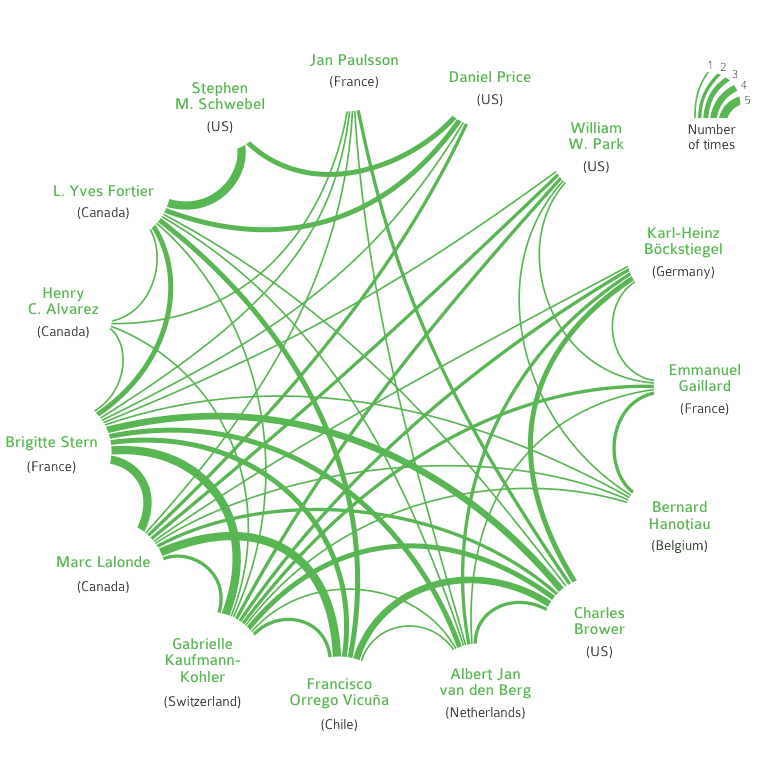
Source: own compilation. For a detailed table with all cases see Annex D.171
Once arbitrators with a shared outlook and vested interest in the system form a majority of the tribunal panel, they are in a position to interpret the law in similar way and potentially control its decisions. Some studies have even referred to the role of “collegial politics” in the outcome of the case. Researchers Waibel and Wu have noted, “an arbitrator may vote differently depending on who the two co-arbitrators are”72.
But close ties among members of the club extend beyond their role as co-arbitrators. There are also a significant number of cases where one or more of the elite 15 is part of the arbitration panel, while another, this time in the role of counsel, represents one of the parties (see Annex D.2). In some cases up to four members of the elite 15 have been involved in the same case (see Annex D.3)73. When acting as counsels, arbitrators can argue for a certain interpretation of the treaty clauses. In fact, it is the counsels who first bring forward key arguments. Arbitrators cannot, in principle, decide a case based on positions that have not been already introduced during the proceedings.
A close relationship between the arbitrator and the counsel could well be cause to question their impartiality in the process. While it is largely accepted that the integrity of the process would be compromised if lawyers from the same law firm acted as arbitrators and counsel in the same case, a more lenient approach seems to apply in cases when the relationship is close, but not as straightforward as working for the same firm.
This is the case when arbitrator and counsel are both members of the same Chamber. For example Stephen Schwebel from Essex Court Chambers acted as counsel for the company and Karl H Bockstiegel, also from Essex Court, was one of the arbitrators in 2003 during the US$700 million dispute between Bayindir Insaat Turizm Ticaret Ve Sanayi v. Pakistan. Two other members of Essex Court Chambers were part of Pakistan’s defence team.
Chambers are not law firms, but they can be described as an “office community” of self-employed lawyers. Some arbitrators like Orrego Vicuña, a member of 20 Essex Street Chamber, have argued that this situation does not lead to conflicts of interest74. However, Park, another prominent arbitrator, indicated that “practice in a collective format, sharing premises and clerks, as well as a common image for the public, can result in significant personal and professional bonds”75.
The perception that arbitrators and counsel from the same chambers acting in the same case could lead to conflicts of interest, was reaffirmed in the case Hrvatska Elektroprivreda, d.d. (HEP) v. Republic of Slovenia. An ICSID tribunal decided that Slovenia could not hire David Mildon as their counsel because Mildon and the chair of the arbitration panel, David A.R. Williams, were both members of Essex Court Chambers76.
The hidden agenda behind the multiple roles of arbitrators
It has become normal for investment arbitrators to constantly switch hats: one minute acting as counsel, the next framing the issue as an academic, or influencing policy as a government representative or expert witness.
Over the last few years these multiple roles have become the subject of some debate. This discussion has focused on the fact that some arbitrators also act as counsel which, in some situations, can raise doubts about the arbitrator’s independence and impartiality.
A common example is when an arbitrator has to decide without prejudice on an issue that the arbitrator has previously defended as an advocate. Park explained the conundrum: “On occasion, an arbitrator must address, in the context of an arbitration, the very same issue presented to him or his law firm as advocate in another case, or to himself as scholar in academic writings. It is not difficult to see why such situations might compromise the integrity of the arbitral process”77.
Lawyers cannot always move comfortably between arguing a point of legal interpretation and sitting on a tribunal deciding the issue.
William W. Park, arbitrator78
Box 8Dan Price: a case of revolving doorsDan Price has never been GAR magazine’s arbitrator of the year but, if GAR had a category for the arbitrator with the most hats, he would be the undisputed winner. Government official negotiating investment treaties, check; corporate lobbyist advocating investor-state dispute settlement, check; counsel defending the interest of corporations, check, prolific media commentator promoting neoliberalism, check; and arbitrator; check. It is common for lawyers to retire into the role of arbitrators, having held positions in government. However, Price has spun through the revolving doors between government and the arbitration circuit several times in the last 20 years. His advocacy for investment protection and investor-state arbitration has been consistent throughout. Price has also benefited from the investment protection treaties he has promoted and helped negotiate. His roles as arbitrator and counsel (mainly for companies) were many times on cases that relied on the very treaties he helped to shape. As Deputy General Counsel for the Office of the U.S. Trade Representative, he negotiated the US-Russia BIT for the US. When Russia was sued for US$103.6 billion in the largest claim ever, the investors (Yukos/ Hulley/ Veteran Petroleum) appointed him as arbitrator. He also negotiated investment protection under NAFTA. Between 2002 and 2006, he represented Fireman’s Fund Insurance (Allianz) in a case against Mexico. While the trial was on-going, he lobbied the Department of Commerce, House of Representatives, Senate, Department of State, US Trade Representative and the White House on behalf of Allianz79. He has also worked as lobbyist for Monsanto, for the Organization for International Investment, and for a group that represents the country’s leading pharmaceutical research and biotechnology companies80. Price is not a typical investment arbitration champion. By the time he left his first government position in 1992 “he understood globalization from the inside out [...] Price saw a broader order — and a new practice area — emerging from the Uruguay Round of trade talks, the North American Free Trade Agreement, and bilateral investment treaties”, according to the law firm Sidley Austin81. He foresaw the unlimited possibilities to profit from an investment arbitration industry and took on the task of helping develop it. He is known for designing the investor-state provisions and for being one of the first US lawyers to encourage corporations to sue governments by making use of investor-state clauses embedded in investment agreements82. After four years as Chair of the International Trade and Dispute Resolution practice at Sidley Austin, he moved back to a government position in 2007, as senior economic advisor to U.S. President George W. Bush. He was Bush’s personal representative to the G-8 (Tokyo) and spearheaded the first G-20 summit in Washington in 2008. In 2008, when the global economic crisis was at its peak and governments threatened controls on capital flows, Price seems to have perceived a possible threat to the neoliberal global governance structure he had helped create. Luckily, he was in a position where he could influence the debate. The official G20 communiqué stated “We recognize that these reforms will only be successful if grounded in a commitment to free market principles, including the rule of law, respect for private property, open trade and investment, competitive markets [...] we must avoid over-regulation that would hamper economic growth and exacerbate the contraction of capital flows, including to developing countries”83. Exactly the measures Price was advocating84. He returned to Sidley Austin in 2009, but left again in 2011. Unlike other arbitrators who left global firms to limit their connections with investors85 he plans to enhance his links with companies, opening both an independent law practice and a business advisory firm, Rock Creek Global Advisors. From one he offers his services as neutral arbitrator86, in the other he promises to help prospective clients “resolve regulatory or other problems they may confront in their worldwide operations”87. In other words, while he presents himself as impartial arbitrator, he offers advice to corporations on how to avoid or counteract government regulations. Rather than question the potential conflicts of interest, colleagues such as van den Berg and Kaufmann-Kohler have praised the way he has combined the role of independent arbitrator with that of lobbying for transnational corporations88. |
Some of those who acknowledge this problem have put forward proposals on how to deal with the issue (such as a ban on the arbitrator-counsel role, or the proposition that arbitrators are appointed by the institutions and not the parties). However, these initiatives suggest that new rules and guidelines would be enough to solve all possible conflicts of interests.
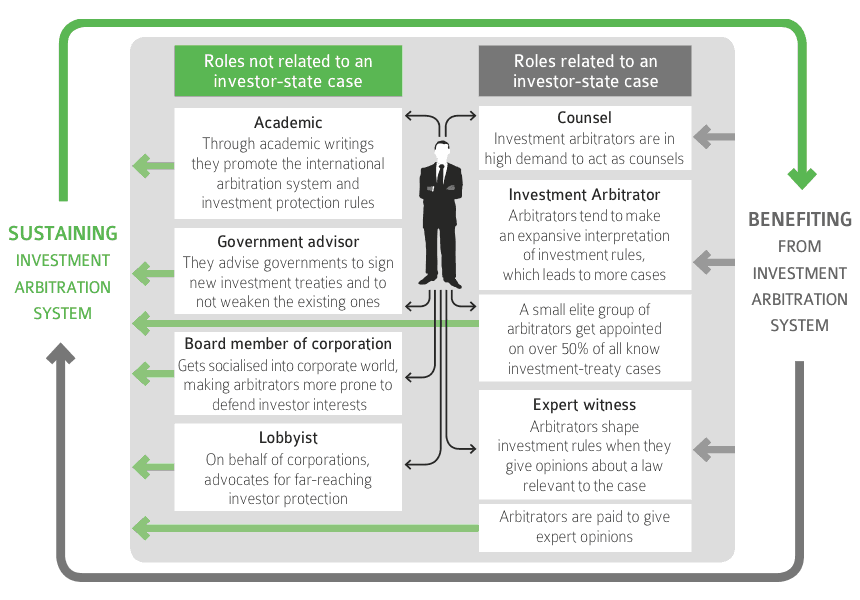
While the dual role of arbitrator-counsel has raised serious concerns and debate among the arbitration community89, what some might see as an even more problematic aspect of arbitrators’ multiple-hats has been largely ignored. Arbitrators are less willing to accept that their multiple roles provide them with the platform to set rules, influence the debate and prevent structural change. In essence, there is an inherent conflict of interest that could be classified as system-related, and which has been long overlooked.
The soccer World Cup is coming soon. Would it be acceptable that the player is also the referee?
Brigitte Stern, arbitrator90
Image 2
How investment arbitrators' multiple roles interact with the investment arbitration system
Promoting the ‘benefits’ of investment arbitration
Elite arbitrators have used different forums to encourage countries to sign investment treaties, to advance laissez-faire economic policy, and promote investor and arbitration-friendly positions. Arbitrators, who claim to be neutral, are employing political rhetoric to push governments into signing investment agreements. And in doing so, there is little evidence that they also warn of the potential risks for states.
BITs are an immense advance in the field and should be nurtured and cherished rather than denounced and undermined.
Judge Stephen M. Schwebel
Well-known arbitrator William W. Park combines the defence of transnational corporations’ economic rights with the assertion that he and his colleagues are not politically biased. “In today’s heterogeneous world”, he wrote, “cross-border investment will be chilled without a willingness of all countries to accept arbitration”. In the same paper he argued “arbitration responds to this apprehension [the bias of host country judges] by providing a forum that is more neutral than host country courts, both politically and procedurally”91.
Park’s claim that there is a direct correlation between signing investment agreements and attraction of Foreign Direct Investment (FDI) is not supported by the facts. Back in 2003, Mary Hallward-Driemeier, a Senior Economist in the World Bank’s Research Department, was already warning that: “analyzing twenty years of bilateral FDI flows from the OECD to developing countries finds little evidence that BITs have stimulated additional investment”92. And his argument that “investors’ economic rights need to be protected”93 tends to overlook investors’ obligations.
Others have resorted to scare tactics. “If international arbitration goes, international economic exchanges will suffer immensely. Nothing will take its place”94 warned Jan Paulsson. Judge Schwebel states that: “the demise of BITs would be regressive for investors, states and the international community”95. And according to Chilean arbitrator Orrego-Vicuña: “if countries don’t sign up to BITs they will have nothing to offer and will lose the investment, as has been seen many times”96. Yet these types of apocalyptic warnings are not based on reality. Brazil, for example, has never signed a BIT and yet receives the largest amount of foreign direct investment of any Latin American country.
Arbitrators have also tried to discredit critics such as journalists and civil society advocates who warn how investment agreements in general and investor-state disputes in particular threaten national sovereignty and democracy97. They claim that they are driven by propaganda, have been misinformed, and do not possess real knowledge of investment arbitration law. Park, for example has argued that “some conspiracy theorists, often journalists or academics, gain traction by targeting arbitration as an inherently unfair process”98. Paulsson has dismissed critics as “shrill voices ... who float propaganda” suggesting that those who question international investment law, have no respect for the rule of law99. To associate all critiques with conspiracy theories or disrespect for the rule of law is a highly defensive reaction, and suggests a community that is unwilling to accept there may be a need for systemic reforms.
Challenging the status quo is not an option
In 2004, the US government, which had been sued several times by Canadian companies under NAFTA, introduced a new BIT template (usually called a Model BIT) which modified the 1994 version. The revised text included new language that would afford the US state some policy space to regulate, particularly in the areas of health and environment. Even though environmental and labour organisations deemed the changes inadequate, prominent US arbitrator Judge Schwebel vocally condemned the changes100.
Price, who had helped to negotiate BITs on behalf of the US, also argued against weakening the provisions in the US Model BIT.101 Park said that “this policy shift is highly problematic, and ultimately will cause significant harm to American interests abroad”102.
My proposition is that any proposal that alters any of the fundamental elements of international arbitration constitutes an unacceptable assault on the very institution [...] Conversely, any proposal that does not attack these fundamental elements, but instead is designed to enhance them, should be considered carefully and may be found to represent an improvement to the process.
Charles Brower, arbitrator103
In 2009, Barack Obama vowed as a Presidential candidate to review the 2004 model BIT to increase labour and environmental obligations. But when the new text came out in 2012 no substantive changes had been made104. Judge Schwebel was part of the government’s advisory committee and, together with the business lobbies, advocated a return to stronger investment protection as contained in the 1994 Model BIT105. He seems to have got his way.
At the same time, investment lawyers were confronted with the possibility of reform of investment treaties in the EU (see chapter 3). Civil society groups had long advocated a whole new generation of investment agreements which better balanced private and public interests106. The EU Commission and the European Parliament seemed to be moving in that direction107. Arbitrators did not waste any time putting forward their “neutral” points of view. Lalonde, for example, expressed concern that the EU’s new investment policy would weaken investor protection. He noted that, for Canada it would be an advantage to negotiate a single European BIT rather than 27 BITs, but warned: “A proviso would be that, we don’t end up with a second rate product or a weaker product than what is available at the present time when we negotiate on a bilateral basis with individual countries”108.
The French arbitrator Emmanuel Gaillard raised concerns about the European Commission’s proposal to phase out BITs between EU Member States (Intra-EU BITs)109. Gaillard warned that the “effort to create a level playing field for investment in Europe will have the unintended consequence of driving companies that wish to invest in Europe away from the European Union”110. Like his colleagues, he seemed to believe that investment agreements are necessary to attract FDI, whereas the evidence is inconclusive111. Perhaps the fact that Gaillard has himself arbitrated in at least three intra-EU BIT cases provides some explanation as to why he was so concerned to maintain these agreements112.
More recently, the Union of South American Nations (UNASUR) have discussed setting up an arbitration centre that could replace ICSID113. This would address some perceived flaws in the current arbitration rules. Asked about his views on this idea, Chilean elite arbitrator Francisco Orrego-Vicuña stated: “The result would be a sort of anti-investment arbitration forum, providing an alternative to ICSID and other forums that are perceived as too investor-friendly. I don’t think it’s a good idea – since such an institution would almost certainly be perceived as too state friendly, and that wouldn’t be satisfactory to investors”114. It is remarkable that Orrego-Vicuña does not appear to realise the inherent double standard in his comment. While he defends a perceived investor-friendly system, a system that could be perceived state-friendly is unacceptable.
As a tight-knit community of arbitrators, who have influential positions in the legal and political field of state-investor relations, arbitrators have tried to ensure that no substantial reforms are implemented which could compromise their own financial position.
Sign here please
Companies can only sue governments when the latter have agreed to international arbitration in investment agreements. For investment lawyers this means: no investment agreement, no cases. No cases, no appointments as arbitrator or counsel.
There have been occasions where elite arbitrators’ role as government advisors have provided them with the opportunity to advocate signing investment treaties that include broad protection for investors.
For example, in the 1990s, Paulsson advised the Mexican government during the negotiation of investment protection rules (Chapter XI) in NAFTA115. This later provided a well-paying appointment when he presided on two arbitration panels where companies sued Mexico invoking that treaty.
[Investment] rules tend to be crafted by the people who inevitably go out and then use them.
Investment Arbitration specialist116
Gaillard was not retained as government advisor, but used a public conference in Mauritius to encourage the Mauritius government to sign investment treaties. He went on to recommend the inclusion of broad investor-friendly protection clauses in new BITs117 118.
Price, who has negotiated investment treaties on behalf of the United States, led negotiations on Chapter XI of NAFTA, where he evidently helped persuade the Mexican government to accept investor-state arbitration119. As a result, the Mexican government dropped the principle that only national courts should have the jurisdiction to hear a case brought by foreign investors (known as the Calvo doctrine) which was part of the Mexican constitution. Price later reaped the benefits when he was hired by two different American companies to sue Mexico due to breach of NAFTA rules120.
Vague rules, more disputes
There is a whole range of investment protection clauses embedded in investment agreements. The alleged breach of one or more of these provisions by the host state gives companies the right to sue. When clauses lack precision, they open the door for companies to sue in a variety of situations that would otherwise not be allowed. The United Nation Conference on Trade and Development (UNCTAD) has noted that “many IIA [international investment agreements] provisions are loosely phrased”. As a consequence, the only thing that stands between the vague rules of investment treaties and a claim from an investor is how the clauses are interpreted by the arbitrators121. If the provision is not precise, it is open to wide interpretation. This shows how important their role is.
An expansive interpretation of minimalist treaty language can give rise to a lack of predictability in the application of the standard. This, in turn, may lead to the undermining of legitimate State intervention for economic, social, environmental and other developmental ends.
UNCTAD122
The obligation for states to grant fair and equitable treatment (FET) to investors which appears in the great majority of international investment agreements is a good example. It is regarded as one of the most unqualified and imprecise of the clauses, and has emerged, according to UNCTAD, “as the most relied upon and successful basis for IIA claims by investors”123. UNCTAD has also pointed out that arbitrators have “interpreted the FET concept rather broadly”, concluding that “the result may be an open-ended and unbalanced approach, which unduly favours investor interests and overrides legitimate regulation in the public interest”124.
In a recent statistical study based on 140 investment-treaty cases, Professor Gus Van Harten found evidence that arbitrators tend to adopt an expansive (claimant-friendly) interpretation of various clauses, such as the concept of investment. He also found that arbitrators were more likely to have an expansive interpretation of the clauses when the investor in the dispute was from France, Germany, the UK or the US125.
Arbitrators can also promote an expansive interpretation when they act as counsel. In the NAFTA case Fireman’s Fund v. Mexico, the investor, an insurance company, claimed that Mexico expropriated its financial investment. This was a result of Mexico’s emergency measures during the financial crisis in 1997. The interpretation of the expropriation clause was crucial in the decision. The investor’s counsel, Price and Schwebel reportedly wrote an 82-page report making the case that expropriation should be interpreted in a broader way than the notion of confiscation of property126.
Professor Van Harten opened up a heated debate when he pointed out that arbitrators appear to have financial and career interests in interpreting the law in an expansive way. He argued there was an incentive to secure future appointments as well as to please the party (the corporations) as they can initiate disputes, saying: “arbitrators may be influenced by a need to appease actors with power or influence over specific appointment decisions as well as the wider position of the relevant arbitration industry”127.
This proposition has been recently backed by Singaporean attorney general Sundaresh Menon who noted that it is “in the interest of the entrepreneurial arbitrator to rule expansively on his own jurisdiction and then in favour of the investor on the merits because this increases the prospect of future claims and is thereby business-generating. This hints at a modern-day uber-sophisticated ambulance-chasing plaintiffs’ lawyer”128.
While arbitrators tend to apply an expansive interpretation of the clauses that favours the investor, they have taken a restrictive approach in a wider context of international law when it comes to human and social rights. In May 2012, the European Center for Constitutional and Human Rights tried to file a written statement (amicus curiae) to an arbitral tribunal hearing two cases against Zimbabwe129. The cases related to timber plantations. The statement argued that the plantation land in dispute was located on ancestral territories belonging to indigenous peoples, and so the decision of the Tribunal would have an impact on the indigenous communities’ rights to their lands. The Tribunal, chaired by Yves Fortier, refused even to hear these concerns130.
International Court of Justice Judge Bruno Simma has noted that “giving adequate consideration to economic and social rights is the exception rather than the rule in investor-state arbitration” and has advocated greater contemplation of international environmental and human rights law131. Elite arbitrators, practitioners and companies reacted strongly against this proposal132. It exposes a certain hypocrisy when arbitrators encourage an expansive interpretation as long as it favours the investor, but consider the idea of a more expansive approach that favours the interests of other actors, such as victims of human rights abuses, to be unacceptable.
I have always found the submission of expert legal opinions on matters of international law to investment treaty tribunals rather odd.
Andrew Newcombe, University of Victoria Faculty of Law133
Trust the expert
Expert witnesses in trials are usually associated with technical or scientific expertise. However, it has become common practice in investor-state cases to call in other investment lawyers as experts to argue the substantive legal question that is central to the case. The expert will discuss a specific clause in the agreement or will interpret that clause in light of the specific case, on behalf of one side. In essence, senior practitioners, who are likely to be arbitrators themselves, “come in and tell their peer arbitrators what the law is and how the law should apply”134. Paulsson, one of the elite arbitrators, has provided such expert opinions135. This practice would be unacceptable in any other judicial process136.
This role enables them to shape the development of the system from another angle. It also happens to be quite lucrative.
Promoting reform to pre-empt structural changes
There is currently a backlash against the investment arbitration system137. The perceived legitimacy of the system is eroding (see chapter 2). With this pressure on investor-state arbitration, it is not surprising that elite arbitrators are looking for ways to support it.
Some arbitrators have been more receptive than others to the critiques and actions by governments to regain some policy space to regulate. Park, for example, has noted that “If investment arbitration is to fulfil its promise [...] some mechanism must be found to promote greater sensitivity to vital host state interests. Otherwise, investor/government arbitration may fall prey to public pressure arising from a backlash against investor victories”138.
Honatiau put it more bluntly, saying investment arbitration must confront the challenges. He has acknowledged the need to review the roles of all arbitration participants and accept some changes in the way the system works. He said: “It is only at this price that arbitration will remain in the decades to come the “natural judge” of international commerce”139.
While some high profile arbitrators have acknowledged that there is a legitimacy problem, many of their proposed reforms - such as Paulsson and van den Berg’s suggestion that the institutions that administer investor-state disputes (such as ICSID, LCIA, ICC, etc.) should appoint the entire panel instead of the parties140 or that there should be greater transparency - would not challenge the pro-investor bias in the system141.
Today, there are ideas floating about which constitute very significant threats to arbitration. I hope these threats can be averted because I favour arbitration as a matter of political policy. But if they cannot, let us at least make the challengers realise that whatever may be their objections to arbitration, international arbitration is something else.
Jan Paulsson, arbitrator and head of the international arbitration department, Freshfields142
Charles Brower rightly noted that the arbitration community is only prepared to accept reforms as long as “such strategies do not require a fundamental redesign of the entire system”143. So while they may be a sincere attempt to improve a flawed system, they are at the same time fundamentally an exercise in self-preservation.
Arbitrators enjoy a privileged position of influence and power due to their different roles. As academics they are able to shape knowledge and understanding of the field, advance theory that promotes practice, and help to shape the investment lawyers of tomorrow. As government officials, they can negotiate investment treaties containing far-reaching investment protection clauses. As experts in the field, they can promote the investor-state arbitration system and advocate for flexible wording in investment rules. As arbitrators they can interpret vague language, creating the potential for more work by doing so.
If investment law firms can be characterised as ambulance-chasers encouraging “victims” to take advantage of the laws that protect them (see chapter 3), arbitrators could be seen as the ones creating the conditions for the accidents to happen.
Yet, few insiders seem disturbed by these facts. A plausible explanation as to why these types of conflicts may be less acceptable in the investment community lies in the fact that they cut to the core of how the system operates and sustains itself. It cannot be fixed by applying stricter procedural rules. It demands system-change.
This new age of arbitration is in fact its golden age […] Never before have so many controversies been left to the disposal of arbitrators; and never before has so much autonomy been afforded them.
Sundaresh Menon SC, Chief Justice of Singapore144
|
 The investment arbitrator’s toolbox
References chapter 4:
- 1. Perry, Sebastian (2012) STOCKHOLM: Arbitrator and counsel: the double-hat syndrome, Global Arbitration Review, Volume 7 - Issue 2, 15 March, http://www.globalarbitrationreview.com/journal/article/30399/stockholm-a... [7-11-2012].
- 2. Van Harten, Gus (2010) Investment Treaty Arbitration, Procedural Fairness, and the Rule of Law, Chapter 20, in Ed. Stephan W. Schill, International Investment Law and Comparative Public Law. Oxford University Press, http://www.oxfordscholarship.com/view/10.1093/acprof:oso/9780199589104.0... [10-7-2012].
- 3. Perry, Sebastian (2011) The American president: an interview with Rusty Park, Global Arbitration Review, Volume 6 - Issue 2, 11 March, http://www.globalarbitrationreview.com/journal/article/29288/the-america... [7-11- 2012].
- 4. International Centre for Settlement of Investment Disputes -ICSID) fees are set at US$3000 a day, https://icsid.worldbank.org/ICSID/FrontServlet?requestType=ICSIDDocRH&ac... London Court of International Arbitration (LCIA) set the hourly rate at US$ 700 an hour (£450), http://www.lcia.org/Dispute_Resolution_Services/LCIA_Arbitration_Costs.aspx. [7-11- 2012]. Other arbitral institutions will calculate arbitrator’s fee as a proportion of the amount in dispute (ICC).
- 5. International Chamber of Commerce - ICC (2012) Rules of Arbitration, http://www.iccwbo.org/products-and-services/arbitration-and-adr/arbitrat... [7-11-2012].
- 6. Chevron and Texaco v. Ecuador (2011) Final Award, http://cdn.lbresearch.com/files/gar/articles/20110831_Final_Comme_40973a... [6-11-2012] Original amount €652,120 (exchange rate US$1.44 per Euro on 31-8-2011).
- 7. Jan Oostergetel and Theodora Laurentius v. Slovakia (2012) Final Award, http://www.italaw.com/sites/default/files/case-documents/ita0933.pdf [8-11-2012] Original amount €500 (exchange rate US$1.32 per Euro on 23-4-2012).
- 8. Barker, Emily (2005) Editor’s Note, Focus Europe. An American Lawyer supplement 27:6, summer.
- 9. Samuels, David (2006) Roundtable: the under 45s versus the heavyweights, Global Arbitration Review, Volume 1 - Issue 5, 1 November, http://www.globalarbitrationreview.com/journal/article/16467/roundtable-... [7-11-2012].
- 10. Kapeliuk, Daphna (2010) The Repeat Appointment Factor - Exploring Decision Patterns of Elite Investment Arbitrators, Cornell Law Review 96:47, p.77, http://www.lawschool.cornell.edu/research/cornell-law-review/upload/Kape... [8-9- 2012].
- 11. Goswami, Nina (2008) ICC left reeling as arbitration court chairman Tercier resigns, The Lawyer, 31 March, http://www.thelawyer.com/icc-left-reeling-as-arbitration-court-chairman-... [7-11-2012].
- 12. Interview with international investment law researcher who asked to remain anonymous, 1 June 2012.
- 13. ICSID (2012) Caseload – Statistics Issue 2012‐2, p16, http://icsid.worldbank.org/ICSID/FrontServlet?requestType=ICSIDDocRH&act... [10-9-2012].
- 14. See Annex A: www.tni.org/profiting-annex-a
- 15. Van Harten, Gus (2012) The (lack of) women arbitrators in investment treaty arbitration. FDI Perspectives, p.1, http://ssrn.com/abstract=2005336 [30-10-2012].
- 16. Ross, Alison (2010) Brigitte in Brazil, Global Arbitration Review, Volume 5 - Issue 3, 5 July, http://www.globalarbitrationreview.com/news/article/28494/brigitte-brazil [7-11-2012].
- 17. Van Harten, Gus (2012) Arbitrator Behaviour in Asymmetrical Adjudication: An Empirical Study of Investment Treaty Arbitration, Osgoode Hall Law Journal, Forthcoming, http://ssrn.com/abstract=2149207 [7-11-2012].
- 18. Yackee, Jason (2012) The Emerging System of International Arbitration, Summary of presentation during American Society of International Law 106th Annual Meeting, http://asilcables.org/2012/03/31/the-emerging-system-of-international-ar... [7-11-2012].
- 19. Dezalay, Yves and Garth, Bryant G. (1996) Dealing in Virtue. International Commercial Arbitration and the Construction of a Transnational Legal Order, Chicago and London p.195.
- 20. Park, W. and Alvarez, G (2003) The New Face of Investment Arbitration: NAFTA Chapter 11, The Yale Journal of International Law, vol. 28, p. 394.
- 21. Perry, Sebastian (2011) Arbitrators and human rights, Global Arbitration Review, 13 June, http://www.globalarbitrationreview.com/news/article/29527/arbitrators-hu... [7-11-2012].
- 22. IIAPP website (2011) The unique authority of international investment arbitrators, september, http://www.iiapp.org/media/uploads/unique_powers_of_investment_arbitrato... [7-11-2012].
- 23. Kasenetz, Eric David (2010) Desperate times call for desperate measures: the aftermath of Argentina’s state of necessity and the current fight in the ICSID, The George Washington International Law Review, Vol 41, pp 109-747.
- 24. Karadelis, Kyriaki (2011) Does arbitration need a breath of fresh air?, Global Arbitration Review, 2 December, http://www.globalarbitrationreview.com/news/article/30006/does-arbitrati... [7-11-2012].
- 25. Van Harten, Gus and Schneiderman, David et al (2010) Public statement on the international investment regime, http://www.osgoode.yorku.ca/public_statement [7-11-2012].
- 26. Toulson, Tom (2010) Investment treaty arbitration is ‘unfair’, say academics, Global Arbitration Review, 10 September, http://www.globalarbitrationreview.com/news/article/28724/investment-tre... [7-11-2012]
- 27. Interview with international investment law researcher who asked to remain anonymous, 1-6-2012.
- 28. Samuels, David (2006), see endnote 9.
- 29. Barker, Alyx (2012) Taking on the “inner mafia”, Global Arbitration Review, 2 October, http://www.globalarbitrationreview.com/news/article/30863/taking-inner-m... [7-11-2012].
- 30. All statistics presented in the chapter are based on known investment-treaty cases including different rules (UNCITRAL, ICSID, etc), unless specified. The data was collected by the authors combining a search in different databases: United Nations Conference on Trade and Development (UNCTAD)- 394 cases (1987-2010), International Investment Arbitration and Public Policy (IIAPP)-249 cases (1987-2010), Investment Treaty Arbitration (ITA) (1990-2012), ICSID cases (1972-2012), references in their own CVs and references in Investment Arbitration Reporter. For a detailed list of the 247 cases, see ANNEX B: www.tni.org/profiting-annex-b.
- 31. UNCTAD (2012) World Investment report. Towards a New Generation of Investment Policies, http://unctad.org/en/Pages/DIAE/World%20Investment%20Report/WIR2012_WebF... [7-11-2012].
- 32. See annex B: www.tni.org/profiting-annex-b and annex C: www.tni.org/profiting-annex-c
- 33. There are 559 arbitrators accredited to the Panels of Arbitrators at ICSID. This is an indication of the amount of investment arbitrators who are qualified and available to arbitrate on investor-state cases. However, it is worth noticing that not all of the elite 15 are accredited to ICSID, but that doesn’t impede them to arbitrate as long as one of the parties appoints them. List of members of the Panel of Conciliators and Arbitrators of ICSID/ 10-7-2012: http://icsid.worldbank.org/ICSID/FrontServlet?requestType=ICSIDDocRH&act... [7-11-2012].
- 34. It is worth noting that information on arbitrators’ roles is usually kept secret. Of particularly difficulty is finding out if lawyers who act as arbitrators also act as counsels. We have been able to recount some cases in which eight of the elite 15 arbitrators have played the role of counsels. These eight are the ones who tend to mention the cases as counsel in their own CVs. For the rest, they either never played counsel role, or the information is not available.
- 35. See annex B: www.tni.org/profiting-annex-b
- 36. Ross, Alison (2010), see endnote 16.
- 37. Ibid.
- 38. Ross, Alison (2012) LONDON: Build on the classic model, urges Brower, Global Arbitration Review, Volume 7 - Issue 3, 21 May, http://www.globalarbitrationreview.com/journal/article/30558/london-buil... [7-11- 2012].
- 39. The Metropolitan Corporate Counsel (2009) A World-Class International Arbitrator Speaks!, the Editor’s interview with Charles N. Brower, p. 24, http://www.metrocorpcounsel.com/pdf/2009/August/24.pdf [7-11-2012].
- 40. Curriculum Vitae Francisco Orrego-Vicuña, http://www.rzuser.uni-heidelberg.de/~p00/down/cv_orrego.pdf [7-11- 2012].
- 41. Orrego-Vicuña has a track record of defending the Pinochet regime. In 1998, when Pinochet was facing extradition to Spain, Orrego-Vicuña wrote an opinion, where he claimed that Pinochet’s government “was not insensitive to human rights issues” and he pleaded the UK not to extradite the former dictator. See www.elclarin.cl/images/pdf/19981211OrregoVicuConfidentialOpinionSpain.pdf [7-11-2012].
- 42. Ross, Alison (2010) From ICCA to the icecaps: an interview with Francisco Orrego Vicuña, Global Arbitration Review, Volume 5 - Issue 4, 1 September, http://www.globalarbitrationreview.com/journal/article/28666/from-icca-i... [7-11-2012].
- 43. Reuters (2012) Sherritt International Corporation (S.TO), http://www.reuters.com/finance/stocks/companyOfficers?symbol=S.TO [2-11-2012].
- 44. Curriculum Vitae of L. Yves Fortier QC, http://www.20essexst.com/member/yves-fortier [7-11-2012].
- 45. Norton Rose (2011) Revered international arbitrator, Yves Fortier, leaving Norton Rose OR to establish independent practice, http://www.nortonrose.com/news/57534/revered-international-arbitrator-yv... [7-11-2012].
- 46. Ross, Alison (2010) An Interview with Yves Fortier, Global Arbitration Review, 19 February, http://www.globalarbitrationreview.com/news/article/27665/an-interview-y... [7-11-2012].
- 47. Global Arbitration Review (2008) Co-arbitrators reject challenge to Kaufmann-Kohler, 1 June, Volume 3 - Issue 3, http://www.globalarbitrationreview.com/journal/article/15844/co-arbitrat... [7-11-2012].
- 48. Global Arbitration Review (2009) Kaufmann Kohler leaves UBS board, 20 March, http://www.globalarbitrationreview.com/news/article/15179/kaufmann-kohle... [7-11-2012].
- 49. Ross, Alison (2011) The first boutique?, Global Arbitration Review, Volume 6 - Issue 5, 23 September, http://www.globalarbitrationreview.com/news/article/29837/the-first-bout... [7-11-2012].
- 50. Enron v. Argentina (ICSID Case No. ARB/01/3) and LG&E v. Argentina (ICSID Case No. ARB/02/1). Both cases arose out of same circumstances: Argentina’s 2001-2002 economic crisis, and in both cases Argentina claimed a state of necessity defence in light of the crisis. While the LG&E Tribunal ruled in favour of Argentina, seven months later, the Tribunal in Enron case ruled against Argentina.
- 51. British Gas (BG) v. Argentina (International Chamber of Commerce (UNCITRAL), http://italaw.com/documents/BGvArgentina.pdf and Abaclat and others v. Argentine Republic (ICSID ARB/07/5), http://italaw.com/documents/Abaclat_v_Argentina_Request_for_Disqualifica... [7-11-2012].
- 52. Bockstiegel, Karl-Heinz (2007) Enterprise v. State: the New David and Goliath?, Arbitration International, vol. 23, no. 1, http://www.claytonutz.com/ialecture/2006/transcript_2006.html [7-11-2012].
- 53. Toulson, Tom and Ross, Alison (2011) And the winner is… GAR’s pick of the best, Global Arbitration Review, 4 March, http://www.globalarbitrationreview.com/news/article/29299/and-winner-is-... [7 November 2012].
- 54. Elward, David (2010) Hanotiau in demand as speaker, Global Arbitration Review, 20 September, http://www.globalarbitrationreview.com/news/article/28720/hanotiau-deman... [7-11-2012]
- 55. Ross, Alison (2011) Boutique firm to gain Singapore outpost, Global Arbitration Review, 9 December, http://www.globalarbitrationreview.com/news/article/30031/boutique-firm-... [7-11-2012]
- 56. Other elite arbitrators have given up their posts in international law firms quoting possible increasing conflicts of interest. These include: Gabrielle Kaufmann-Kohler, Albert Jan van den Berg, Bernard Hanotiau, Yves Fortier and Marc Lalonde.
- 57. Paulsson, Jan (2011) Moral Hazard in International Dispute Resolution, Transnational Dispute Management, vol. 8, no. 2, p. 6.
- 58. Paulsson, Jan (2009) Repudiation of International Arbitration Agreements and the Public Interest, Kluwer Arbitration Blog, 16 February, http://kluwerarbitrationblog.com/blog/2009/02/16/repudiation-of-internat... [7-11-2012].
- 59. Dingle, Lesley and Bates, Daniel (2009) A Conversation with Judge Stephen M. Schwebel, the Squire Law Library and the Faculty of Law, Cambridge University, http://www.squire.law.cam.ac.uk/Media/Eminent%20Scholars%20Archive%20Tra... [7-11- 2012].
- 60. Global Arbitration Review (2010) Judge Schwebel at 81, Volume 5 - Issue 2, 12 May, http://www.globalarbitrationreview.com/news/article/28402/judge-schwebel-81 [7-11-2012]
- 61. Ibid and Perry, Sebastian (2011) Schwebel condemns ‘neutering’ of BITs, Global Arbitration Review, 10 May, http://www.globalarbitrationreview.com/news/article/29451/schwebel-conde... [7-11-2012].
- 62. Kirby, P.E.; Alvarez, H.C. and Ullrich, D. (2009) Canada-EFTA Free Trade Agreement Enters Into Force, International Trade and Customs Law Bulletin, Fasken Martineau, July 1, p.2, http://www.fasken.com/canada-efta-free-trade-agreement-enters-into-force... [7-11-2012].
- 63. In the case in the case RFCC v Morocco, Gaillard acting as counsel, was trying to annul an award that Ghana was going to use for its own defence in the case Telekom Malaysia v. Ghana where he was the arbitrator.
- 64. Gaillard, Emmanuel (2009) Russia cannot walk away from its legal obligations, Letter to the Editor, Financial Times, 18 August, http://www.ft.com/intl/cms/s/0/c63d918a-8b8d-11de-9f50-00144feabdc0.html... [7 November 2012].
- 65. Ross, Alison (2011) Killing off intra-EU BITs: how the European Commission plans to level the playing field for investors, Global Arbitration Review, Volume 6 - Issue 5, 17 October, http://www.globalarbitrationreview.com/news/article/29884/killing-off-in... [7-11-2012].
- 66. Park, W. and Alvarez, G (2003), see endnote 20, p. 396.
- 67. Park, W. and Alvarez, G (2003), see endnote 20, p. 383.
- 68. Schneiderman, David (2010) Judicial Politics and International Investment Arbitration: Seeking an Explanation for Conflicting Outcomes, Northwestern Journal of International Law & Business 30, no. 2, http://ssrn.com/abstract=1965629 and Waibel, Michael and Wu, Yanhui (2011) Are arbitrators political?, http://www.wipol.uni-bonn.de/lehrveranstaltungen-1/lawecon-workshop/arch... [5-11-2012].
- 69. See annex D: www.tni.org/profiting-annex-d
- 70. D. Price resigned in 2007 to accept a White House appointment and was replaced by Charles Poncet.
- 71. See annex D: www.tni.org/profiting-annex-d
- 72. Waibel, Michael and Wu, Yanhui (2011), see endnote 68, p.19.
- 73. See annex D: www.tni.org/profiting-annex-d
- 74. Ross, Alison (2010), see endnote 41.
- 75. Perry, Sebastian (2011), see endnote 3.
- 76. Peterson, Luke Eric (2008) Barrister may not appear as counsel for state in arbitration where another member of chambers sits on tribunal, IA Reporter, 25 November, http://www.iareporter.com/articles/20090929_30? [7-11-2012].
- 77. Peterson, Luke Eric (2010) Arbitrator decries “revolving door” roles of lawyers in investment treaty arbitration, IAReporter, 25 February, http://www.iareporter.com/articles/20100226_1 [7 -11-2012].
- 78. Ross, Alison (2009) CAS puts a stop to role-switching, Global Arbitration Review, 14 October, http://www.globalarbitrationreview.com/news/article/19054/cas-puts-stop-... [7 -11-2012].
- 79. Office of the Clerk, US House of Representatives (2005) Lobbying disclosure form Sidley Austin, http://disclosures.house.gov/ld/pdfform.aspx?id=100015622 [14-11-2012].
- 80. Office of the Clerk, US House of Representatives (2002-2005) Lobbying disclosure form Sidley Austin, http://disclosures.house.gov/ld/pdfform.aspx?id=9013638, http://disclosures.house.gov/ld/pdfform.aspx?id=8072048, http://disclosures.house.gov/ld/pdfform.aspx?id=8086082, http://disclosures.house.gov/ld/pdfform.aspx?id=8104142, http://disclosures.house.gov/ld/pdfform.aspx?id=8130118, http://disclosures.house.gov/ld/pdfform.aspx?id=9013637, http://disclosures.house.gov/ld/pdfform.aspx?id=8067264, http://disclosures.house.gov/ld/pdfform.aspx?id=8083461, http://disclosures.house.gov/ld/pdfform.aspx?id=8114107, http://disclosures.house.gov/ld/pdfform.aspx?id=8130123 [16-11-2012].
- 81. Sidley Austin website (2012) International Trade Practice, http://www.sidley.com/en-US/internationaltradeaccolades/linkedContent.aspx [7 -11-2012].
- 82. Greider, William (2001) The Right and US Trade Law: Invalidating the 20th Century, The Nation, 17 November, http://www.thenation.com/article/right-and-us-trade-law-invalidating-20t... [16-11-2012].
- 83. The New York Times (2008) Statement From G-20 Summit, http://www.nytimes.com/2008/11/16/washington/summit-text.html [7 -11-2012].
- 84. Price, Daniel (2008) The New Face of Protectionism, The New Yor Times, 1 September, http://www.nytimes.com/2009/09/02/opinion/02iht-edprice.html and Price, Daniel (2009) Protectionism Resurgent, The New York Times, 26 March, http://www.nytimes.com/2009/03/27/opinion/27iht-edprice.html [7 -11-2012].
- 85. Norton Rose (2011), see endnote 44.
- 86. Daniel M. Price PLLC website, http://danielmpricepllc.com [7 -11-2012].
- 87. Rock Creek Global Advisors website, http://www.rockcreekadvisors.com [7-11-2012].
- 88. Elward, David (2011) Daniel Price sets up alone, Global Arbitration Review, 27 June, http://www.globalarbitrationreview.com/news/article/29580/daniel-price-s... [7-11-2012]
- 89. See for example: Bernasconi-Osterwalder, Nathalie et al (2011) Arbitrator Independence and Impartiality: Examining the Dual Role of Arbitrator and Counsel, IISD, http://www.iisd.org/publications/pub.aspx?id=1442; Goldhaber, M.d (2006) Are two hats too many?, Transnational Dispute Management (TDM) 3, no. 2, http://www.transnational-dispute-management.com/article.asp?key=781; or Special Issue on Arbitrator Bias, Transnational Dispute Management (TDM) 4, (2008), http://www.transnational-dispute-management.com/journal-browse-issues-to... [16-11-2012].
- 90. Ross, Alison (2010), see endnote 16.
- 91. Park, W. and Alvarez, G (2003), see endnote 20, p. 369, 396.
- 92. Mary Hallward-Driemeier (2003) Do Bilateral Investment Treaties Attract Foreign Direct Investment? Only a Bit … and They Could Bite, World Bank Policy Research Working Paper, p22, http://elibrary.worldbank.org/content/workingpaper/10.1596/1813-9450-3121 [7-11-2012].
- 93. Judge Charles Brower’s, for example, claimed that: “dispute settlement has a central function in stabilizing the expectations of foreign investors and enables them to counter opportunistic behaviour by the host state, such as unreasonable interferences with the investor’s economic rights. See Brower, C. & Schill, S (2009) Is Arbitration a Threat or a Boon to the Legitimacy of International Investment Law?, Chicago Journal of International Law, p.477.
- 94. Paulsson, Jan (2008) International Arbitration is Not Arbitration, Stockholm International Arbitration Review, p3.
- 95. Global Arbitration Review (2010), endnote 59.
- 96. Ross, Alison (2010), see endnote 41.
- 97. For a recount of the campaign against the Multilateral Agreement on Investment (MAI) see http://www.gppi.net/fileadmin/gppi/Tieleman_MAI_GPP_Network.pdf [16-11-2012]. Articles in mainstream newspapers who presented views of critics to investment protection agreements include: DePalma, Anthony (2001) Nafta’s Powerful Little Secret; Obscure Tribunals Settle Disputes, but Go Too Far, Critics Say, The New York Times, 11 March, http://www.nytimes.com/2001/03/11/business/nafta-s-powerful-little-secre... and Malik, Mahnaz (2011) The legal monster that lets companies sue countries, The Guardian, 4 November, http://www.guardian.co.uk/commentisfree/2011/nov/04/bilateral-investment... [7-11-2012].
- 98. Perry, Sebastian (2011), see endnote 3.
- 99. Schneiderman, David (2010), see endnote 68, p28-29.
- 100. Schwebel, Stephen M. (2009) A critical assessment of the US model BIT, Keynote Address at Twelfth ITF Public Conference, London, 15 May, http://www.biicl.org/files/4253_schwebel-biicl15may2009speech_cor2.pdf [7-11-2012].
- 101. Alvarez, J.E. (2011) The Return of the State, Minnesota Journal of Int’l Law, 20:2, p.241, http://www.minnjil.org/wp-content/uploads/2011/07/Alvarez-Final-Version.pdf [7-11-2012].
- 102. Park, W. and Alvarez, G (2003), see endnote 20, p. 395.
- 103. Ross, Alison (2012), see endnote 37.
- 104. Global Arbitration Review (2012) The new US model BIT: not so very different from the old version, 21 April, http://www.globalarbitrationreview.com/news/article/30488/the-new-us-mod... [7 November 2012]
- 105. U.S. Department of State (2009) Report of the Subcommittee on Investment of the Advisory Committee on International Economic Policy Regarding the Model Bilateral Investment Treaty: Annexes, http://www.state.gov/e/eb/rls/othr/2009/131118.htm [7-11- 2012].
- 106. The Seattle to Brussels (S2B) Network is a pan-European NGO network campaigning to promote a sustainable, democratic and accountable system of trade and investment policies in Europe. See: http://www.s2bnetwork.org/themes/eu-investment-policy.html
- 107. European Parliament (2011) Resolution on the future European international investment policy (2010/2203(INI)), http://www.europarl.europa.eu/sides/getDoc.do?type=TA&reference=P7-TA-20... [7-11-2012].
- 108. Global Arbitration Review (2010) BITs after Lisbon: what mark will the new EU treaty leave?, 15 April, http://www.globalarbitrationreview.com/news/article/28287/bits-lisbon-ma... [7-11-2012].
- 109. von Krause, Christophe (2010) The European Commission’s Opposition To Intra-EU BITs And Its Impact On Investment Arbitration, Kluwer Arbitration Blog, 28 September, http://kluwerarbitrationblog.com/blog/2010/09/28/the-european-commission... [7-11-2012].
- 110. Ross, Alison (2011), see endnote 64.
- 111. World Bank and UNCTAD studies have shown that there is not direct correlation between signing of Investment Agreements and attraction of FDI. See: Mary Hallward-Driemeier (2003), see endnote 92 and UNCTAD (2009) The Role of International Investment Agreements in Attracting Foreign Direct Investment to Developing Countries, http://unctad.org/en/Docs/diaeia20095_en.pdf [7-11-2012].
- 112. Eastern Sugar v. Czech Republic, SCC/082004 (Czech Republic-Netherlands BIT); Binder v. Czech Republic (Czech Republic-Germany BIT); Railworld v Estonia, ICSID Case No. ARB/06/6 (Estonia-Netherlands BIT).
- 113. Fiezzoni, Silvia Karina (2012) UNASUR Arbitration Centre: The Present Situation and the Principal Characteristics of Ecuador’s Proposal, Investment Treaty News, 12 January, http://www.iisd.org/itn/2012/01/12/unasur [7-11-2012].
- 114. Ross, Alison (2010), see endnote 41.
- 115. Paulsson, Jan (1995) Arbitration Without Privity, 10(2) ICSID Review – Foreign Investment Law Journal, p. 248
- 116. Interview with Investment Arbitration specialist who asked to remain anonymous, 8 June 2012
- 117. Emmanuel Gaillard (2010) Response to the Report, Proceedings of the Mauritius International Arbitration Conference 2010 “Flaws and Presumptions: Rethinking Arbitration Law and Practice in a new Arbitral Seat”, Mauritius, 13 and 14 December, p.323, www.pca-cpa.org/showfile.asp?fil_id=1924 [8-11-2012].
- 118. Ross, Alison (2010) Mauritius to benefit from EU turmoil?, Global Arbitration Review, 15 December, http://www.globalarbitrationreview.com/news/article/28990 [7-11-2012]
- 119. Patel, Bimal (2006/2007) Multiple Roles for a Unified Continent: Negotiating NAFTA, p3, http://www.thepresidency.org/storage/documents/Vater/Patel.pdf and Wilkinson, Suzanne M. (2002) NAFTA, Mexico & Metalclad, Master thesis, p.76-79, https://circle.ubc.ca/handle/2429/13062 [7-11-2012].
- 120. Archer Daniels Midland Company and TATE & LYLE Ingredients Americas v. Mexico (ICSID CASE Nº.ARB (AF) /04/5) and Fireman’s Fund Insurance (Allianz) v Mexico (ICSID Case No. ARB(AF)/02/01).
- 121. United Nations Conference on Trade and Development (UNCTAD) (2011) Interpretation of IIAs: What States Can Do, IIA Issues Note, December, p.8, http://www.unctad.org/en/Docs/webdiaeia2011d10_en.pdf [20-10-2012].
- 122. United Nations Conference on Trade and Development (UNCTAD) (2012) Fair and equitable treatment: a sequel, UNCTAD Series on Issues in International Investment Agreements II. New York and Geneva, p21.
- 123. United Nations Conference on Trade and Development (UNCTAD) (2012), see endnote 121, p21.
- 124. United Nations Conference on Trade and Development (UNCTAD) (2012), see endnote 121, p30.
- 125. Van Harten, Gus (2012) Pro-Investor or Pro-State Bias in Investment-Treaty Arbitration? Forthcoming Study Gives Cause for Concern, Investment Treaty News, April 13, http://www.iisd.org/itn/2012/04/13/pro-investor-or-pro-state-bias-in-inv... [7-11-2012]
- 126. Rosero, John D. (2010) Private v public authority in NAFTA: the procyclicality of Investor protections and global governance issues, PhD dissertation, p.318, http://mss3.libraries.rutgers.edu/dlr/showfed.php?pid=rutgers-lib:27211 [16-11-2012]
- 127. Van Harten, Gus (2012), see endnote 17, p.10.
- 128. Ross, Alison (2012) Menon kicks off ICCA Congress with call for regulation, Global Arbitration Review, 11 June,
http://www.globalarbitrationreview.com/news/article/30600/menon-opens-ic... [5-11-2012]. - 129. Border Timbers Limited and others v. Zimbabwe (ICSID Case No. ARB/10/25) and Bernhard von Pezold and others v. Zimbabwe (ICSID Case No. ARB/10/15).
- 130. European Center for Constitutional And Human Rights (2012) Human Rights inapplicable in International Investment Arbitration?. A commentary on the non-admission of ECCHR and Indigenous Communities as Amici Curiae before the ICSID tribunal, Berlin, http://www.ecchr.de/index.php/cr/articles/human-rights-inapplicable-in-i... [7-11-2012].
- 131. Perry, Sebastian (2011), see endnote 21.
- 132. Ibid.
- 133. Newcombe, Andrew (2010) The Strange Case of Expert Legal Opinions in Investment Treaty Arbitrations, Kluwer Arbitration Blog, 18 March, http://kluwerarbitrationblog.com/blog/2010/03/18/the-strange-case-of-exp... [7-11-2012].
- 134. Interview with international investment law researcher who asked to remain anonymous, 1 June 2012.
- 135. Paulsson, Jan (2012) Expert opinion in the case of Chevron and Texaco v. Ecuador, UNICTRAL case, 12 March, http://italaw.com/sites/default/files/case-documents/ita0176_0.pdf [7-11-2012].
- 136. Interview with international investment law researcher who asked to remain anonymous, 1 June 2012.
- 137. Waibel, Michael et al (2010) The Backlash Against Investment Arbitration: Perceptions and Reality. Kluwer Law International.
- 138. Park, W. and Alvarez, G (2003), see endnote 20, p. 399.
- 139. Hanotiau, Bernard (2011) International Arbitration in a Global Economy: The Challenges of the Future, Journal of International Arbitration (Kluwer Law International), vol. 28, issue 2, p. 89-103.
- 140. Paulsson, Jan (2011), see endnote 56.
- 141. It is not even clear to what extent arbitrators are prepared to push through these limited reforms, given the resistance that has previously been evident. For example, Jan Paulsson, defended Bahrain’s delegation position of resisting any attempt to incorporate transparency provisions into the UNCITRAL Rules.
- 142. Paulsson, Jan (2008), see endnote 94, p. 18.
- 143. Brower, C. & Schill (2009), see endnote 93, p.497.
- 144. Menon, Sundaresh (2012) International Arbitration: The Coming of a New Age for Asia (and Elsewhere), speech at ICCA Congress, p. 1-2, http://www.globalarbitrationreview.com/cdn/files/gar/articles/AGs_Openin... [17-11-2012]